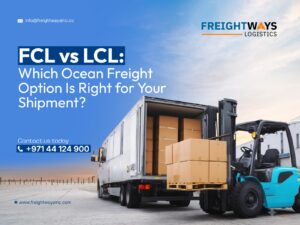
Picture this: you’ve got a shipment ready to leave the factory, a client waiting on the other end, and two very different price quotes sitting in your inbox. One is for a full container. The other splits the cost with a handful of strangers’ cargo. Which one actually gets your goods there faster, cheaper and in one piece?
That question sits at the center of nearly every conversation we have with importers and exporters across the UAE. Whether you’re moving a pallet of samples or twenty tonnes of machinery, understanding the difference between FCL and LCL is the first step to getting your ocean freight services UAE strategy right. Get it wrong, and you either overpay for space you don’t need or wait weeks longer than necessary for your cargo to clear.
This guide walks through exactly how each option works, what it costs, and how to pick the one that fits your business rather than the other way around.
What Do FCL and LCL Actually Mean?
Before comparing the two, it helps to know what you’re actually booking when you choose either method.
Full Container Load (FCL): The Whole Box Is Yours
FCL shipping means your cargo occupies an entire shipping container, whether that’s a 20ft, 40ft, or 40ft high-cube box, and nobody else’s goods travel inside it with yours. You pay a flat rate for the container itself rather than for the space your goods take up, which makes the math simple once your volume climbs high enough.
Because the container is sealed at your supplier’s warehouse and only opened again at destination, FCL tends to involve far less handling. That translates into fewer opportunities for damage, mix-ups, or pilferage along the way.
Less than Container Load (LCL): Sharing the Ride
LCL, sometimes called groupage or consolidated cargo, is what happens when your shipment isn’t large enough to justify a full container on its own. A freight forwarder combines your goods with cargo from other businesses heading to the same general region, and everyone splits the container between them.
You only pay for the cubic meters your cargo actually occupies, which makes LCL shipping a practical entry point for smaller businesses or first-time exporters. The tradeoff is that your goods get loaded and unloaded more than once, since the container has to be opened, sorted and redistributed at a consolidation point.
Key Differences Between FCL and LCL Shipping
Once you understand the basic setup, the real decision comes down to a handful of practical factors. Here’s how the two stack up against each other.
- Cost structure: FCL is priced per container regardless of how full it is, while LCL is priced per cubic meter or weight, whichever is greater.
- Cargo volume: FCL generally becomes the more economical choice once your shipment exceeds roughly 13 to 15 CBM; anything smaller usually fits LCL more comfortably.
- Transit time: FCL moves in a straight line from origin to destination, while LCL cargo often waits at a consolidation warehouse until the container fills up.
- Handling and risk: FCL cargo is sealed once and opened once, whereas LCL cargo passes through multiple hands during consolidation and deconsolidation.
- Customs clearance: FCL shipments typically clear customs faster since only one consignee’s paperwork is involved, while LCL clearance can be slower because every shipper’s documents in the container need processing.
- Flexibility: LCL lets you ship smaller, more frequent batches without tying up capital in unused container space.
None of these points work in isolation. A shipment with a tight deadline might justify FCL even at a lower volume, while a business testing a new UAE supplier relationship might prefer the lower commitment of LCL despite the slower transit.
When Does FCL Make More Sense?
FCL isn’t just for large enterprises moving container loads of raw material. It’s often the smarter option any time volume, timing, or cargo sensitivity tips the scale.
Consider FCL shipping when:
- Your cargo volume is close to or above 13 to 15 CBM, since the per-unit cost usually drops below what LCL would charge for the same volume.
- You’re shipping fragile, high-value, or sensitive goods that benefit from minimal handling.
- Your delivery schedule is tight and you can’t afford the extra days LCL consolidation adds.
- You want a single, uninterrupted chain of custody from the loading dock to your warehouse door.
Businesses running regular replenishment cycles into Jebel Ali Port or Khalifa Port also tend to gravitate toward FCL once order sizes stabilize, since predictable volumes make container bookings easier to plan around.
When Does LCL Make More Sense?
LCL earns its place for a different kind of shipper, and it’s worth resisting the urge to treat it as simply the “cheaper” or lesser option.
LCL shipping tends to work best when:
- Your shipment is under roughly 13 CBM and wouldn’t come close to filling a container.
- You’re launching a new product line and don’t yet have the order volume to justify FCL.
- Cash flow matters more than speed, since you avoid paying for space you don’t use.
- You need to ship smaller batches more frequently rather than large ones occasionally.
For SMEs and e-commerce businesses across the UAE, LCL shipping often becomes the default while order volumes grow, before eventually graduating to FCL as demand increases.
Cost Comparison: FCL vs LCL in Practical Terms
Cost is usually the deciding factor, but the comparison isn’t as simple as looking at a single rate card. FCL pricing is fixed once you book the container, so your cost per unit actually drops as you fill more of the space. LCL pricing scales directly with volume, plus handling fees for consolidation and deconsolidation at both ends.
There’s a crossover point, and it typically sits somewhere between 13 and 15 CBM depending on the trade lane and current freight rates. Below that threshold, LCL usually wins. Above it, FCL almost always comes out ahead. A good freight forwarder in the UAE will run these numbers against your specific shipment rather than relying on rules of thumb, since fuel surcharges, port fees and seasonal demand can shift that crossover point from one quarter to the next.
Why the UAE Is a Strategic Hub for Ocean Freight
The UAE’s position isn’t an accident of geography that shippers happen to benefit from. It’s built into the infrastructure. Jebel Ali Port alone connects businesses to well over a hundred destinations worldwide, and together with Khalifa Port and Port of Fujairah, it gives UAE-based importers and exporters direct access to Asia, Europe, Africa and the Americas.
That connectivity matters just as much for LCL as it does for FCL. High shipping volumes through these ports mean consolidation containers fill faster, which keeps transit times more predictable than they’d be in a smaller market. Whether you’re routing FCL containers to a regional distribution center or consolidating LCL cargo bound for GCC markets, the UAE’s port network gives you options that many other hubs simply can’t match.
How a Freight Forwarder Helps You Decide
Choosing between FCL and LCL isn’t a decision you have to make alone, and honestly, it shouldn’t be. A freight forwarder looks at your cargo dimensions, delivery deadlines, budget and destination market, then models both options side by side before recommending one.
At Freight Ways, our ocean freight team also factors in things shippers don’t always think to ask about, like:
- Whether your goods require special handling, temperature control, or hazardous cargo documentation.
- How container availability and vessel schedules at your chosen port are trending that month.
- Whether splitting a shipment across FCL and LCL could actually reduce your total cost.
- What customs documentation your destination country requires for each method.
That kind of hands-on planning is usually what separates a shipment that arrives on time from one that sits in a queue waiting on paperwork.
Making the Right Call for Your Business
There isn’t a universally “better” option between FCL and LCL. There’s only the option that fits your shipment, your timeline and your budget at this particular moment. A growing business might use LCL today and switch to FCL next year as order volumes climb, and that’s a perfectly normal progression rather than a sign anything went wrong earlier.
The smartest approach is to treat this as an ongoing calculation rather than a one-time decision. Revisit it every time your shipment volume, destination, or urgency changes, and lean on a freight partner who can run the comparison for you rather than guessing.
FAQs
What is the main difference between FCL and LCL shipping?
FCL means you book an entire container exclusively for your cargo, while LCL means you share container space with other shippers and pay only for the volume you use.
Is FCL cheaper than LCL?
It depends on your shipment size. FCL is usually cheaper per unit once your cargo volume exceeds roughly 13 to 15 CBM, while LCL is more cost-effective below that threshold since you’re not paying for unused container space.
How long does LCL shipping take compared to FCL?
LCL shipments generally take longer than FCL because cargo has to be consolidated with other shipments before departure and deconsolidated after arrival, adding extra handling time at both ends of the journey.
What size shipment is best suited for FCL container shipping?
As a practical benchmark, shipments of 13 CBM or more are usually better suited to FCL, since the flat container rate becomes more economical than paying LCL charges by volume at that size. Below this, LCL shipping typically offers the better rate.
Can I combine FCL and LCL for the same order?
Yes, some businesses split larger orders across both methods, using FCL for the bulk of the shipment and LCL for smaller, time-sensitive portions, though this depends on your supplier setup and total cargo volume.
Which UAE ports handle FCL and LCL shipments?
The best freight forwarding services for UAE businesses are those that combine sea, air and land transportation with customs coordination, shipment tracking, cargo handling, warehousing and destination delivery, while offering routes and solutions tailored to the shipment’s cargo type, urgency, destination and budget.